NEPHRON
Nephron is the structural and functional unit of the kidney. It act as filters and remove the waste products from blood and forms urine. Each kidney possesses a large number of nephrons approximately one million.
Structure of the Nephron
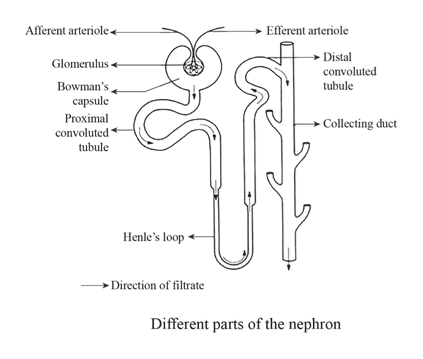
Afferent arteriole and Efferent arteriole
Afferent arteriole is the branch of renal artery which carries blood to the glomerulus capsule while Efferent arteriole carries blood away from the glomerulus to different part of the body.
Bowman’s capsule
A round cup like structure which surrounds or encloses a glomerulus. It serves as a filter to remove organic wastes, excess inorganic salts, and water.
Glomerulus
A network of capillaries surrounded by the Bowman's capsule. It receives and filter blood from afferent arteriole. The blood with large particles is taken from the glomerulus through efferent artery to different parts of body.
Proximal convoluted tube
This is the first convoluted tube extended from Bowman’s capsule to the descending loop of Henle. It helps in reabsorption of glucose, amino acid, potassium and calcium ions.
Loop of Henle
The U-shaped part of the nephron, located between the proximal and distal convoluted tubules. Loop of Henle helps to reabsorb water and salt (Nacl). Animals with long loop of Henle store large amount of water in their body for long period of time. It is one of the adaptive features for animals living in desert area.
Parts of loop of Henle
It is divided into two parts such as descending and ascending.
i. Descending loop of Henle
This part is permeability to water. Therefore, water is reabsorbed.
ii. Ascending part loop of Henle
This part is permeability to sodium ions. Therefore, sodium ions are reabsorbed.
Distal convoluted tubule
This is the second convoluted or coiled tube that extended from the loop of Henle to the collecting duct. At distal convoluted tubule also Sodium ions and water are reabsorbed
Collecting ducts
The collecting ducts are small tubes that direct or drainage urine into the renal pelvis for drainage into the ureter. Once in the ureter, the urine can be pushed into the bladder for elimination.
Questions
1) Why proximal and distal convoluted tubule is highly convoluted?
2) Give reason, why camel adapts well in desert?

No comments:
Post a Comment